In modern commercial cotton farming, harvesting efficiency is fundamentally governed by chemical leaf ablation and uniform boll opening. As the global textile supply chain shifts toward fully automated, high-speed mechanical stripping and spindle picking, the role of Cotton Harvest Aids—specifically chemical defoliants, desiccants, and plant growth regulators (PGRs)—has evolved from an optional management practice to an imperative industrial standard. China stands as the epicenter of synthesis, formulation innovation, and global supply for these specialized active ingredients.
Modern cotton defoliation involves complex biochemical manipulation of the plant's hormonal balance. By triggering premature ethylene production while suppressing auxin translocation within the petiole, advanced chemical agents induce the formation of a natural abscission layer. This process cleanly detaches green foliage without causing immediate cellular necrosis, preventing green leaf stain on raw lint—a critical factor in maintaining fiber grade, trash content compliance, and high market value.
Procurement intent for Chinese cotton harvest aids is driven by regional agronomic shifts, thermal accumulation variations, and labor costs across key cotton-producing regions worldwide. Commercial buyers—ranging from national agricultural distributors to large-scale plantation enterprise buyers—seek stable chemical purity, non-crystallizing liquid suspensions, and customized micro-emulsions.
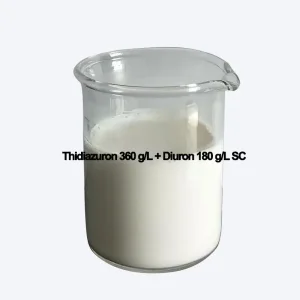
Characterized by high-density planting and high thermal drop-offs during early autumn. Buyers require highly active Thidiazuron (TDZ) + Diuron SC formulations capable of operating effectively under sudden temperature fluctuations down to 15°C.
In markets like Brazil (Mato Grosso) and Bolivia, massive canopy biomass demands heavy-duty tank mixes combining fast-acting desiccants (e.g., Paraquat alternatives or specialized carfentrazone-ethyl) alongside leaf-drop regulators to facilitate twin-spin harvester passes.
In regions across Pakistan, India, Iraq, and Syria, transitional farming models are shifting from manual picking to semi-mechanized practices. Smallpack distribution and stable, long-shelf-life liquid concentrates dominate procurement requirements.
Achieving total canopy clearance and lint preservation relies on combining complementary active ingredients. Modern Chinese formulation engineering focuses on reducing dosage volumes per hectare while maximizing active penetration into dense foliage.
| Active Ingredient / Combination | Primary Physiological Role | Optimal Temperature Window | Recommended Formulation Type | Key Advantage |
|---|---|---|---|---|
| Thidiazuron (TDZ) | Inhibits auxin transport; promotes ethylene & abscission layer formation | > 20°C (Base activity) | 500 g/L SC / 50% WP | Prevents leaf regrowth; clean leaf drop without leaf desiccation sticking |
| Thidiazuron + Diuron SC | Synergistic combination: Photosynthesis inhibition (Diuron) + Hormonal drop (TDZ) | 15°C – 28°C (Enhanced low-temp resilience) | 540 g/L SC (360 TDZ + 180 Diuron) | Exceptional performance in cooler climates; rapid activity speed |
| Ethephon | Releases ethylene directly; accelerates boll dehiscence & uniform ripening | > 18°C | 480 g/L SL / 720 g/L SL | Concentrated boll opening, synchronized harvest timing |
| Cyclanilide + Ethephon | Prevents terminal regrowth while accelerating boll opening | 16°C – 32°C | Pre-mix Liquid Concentrate | Dual action: defoliation + boll opening in single pass |
1. Cuticular Penetration: The addition of specialized surfactants (silicone or methylated seed oils) breaks droplet surface tension, allowing rapid penetration through the thick waxy cuticle of mature cotton leaves.
2. Auxin Transport Disruption: Thidiazuron disrupts polar auxin transport within the leaf blade, reducing auxin levels at the petiole base.
3. Abscission Cell Lysis: Hydrolytic enzymes (cellulase and pectinase) synthesize, digesting the middle lamella of cells in the abscission zone.
4. Gravity Leaf Drop: Leaves detach cleanly under their own weight within 7–14 days, leaving bare stalks and fully exposed, mature bolls ready for stripping.
Awiner Biotech was founded in 2006, located in north of China-Shijiazhuang, Hebei Province. The city is close to our capital Beijing, transportation is convenient. Awiner Biotech is committed to research, produce and distribute agrochemicals. mainly deal with pesticides, herbicides, fungicides, plant growth regulator and public health pesticides.
Up to now, we have won customers from Iraq, Iran, Afghanistan, Pakistan, India, Libya, Syria, Turkey, Yemen, Ukraine, Russia, Kazakhstan, Uzbekistan, Chile, Bolivia, Mexico, Brazil, Paraguay, Nigeria, Djibouti, Rwanda, Somalia, Malaysia, Cambodia, Nepal, Myanmar and so on.
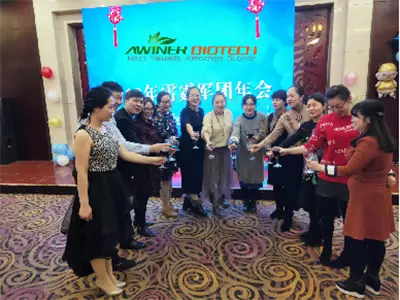
Our countries participating in the exhibition are Turkey, Iran, Pakistan, Nigeria, Russia, Cambodia, Malaysia, Uzbekistan, etc. We regularly meet our global business partners to demonstrate our latest synthesis and formulation innovations.
We go to the customer's country to conduct market inspections, analyze and solve problems for them, understand their product usage, and customers will also visit us in Shijiazhuang to audit our quality assurance protocols.
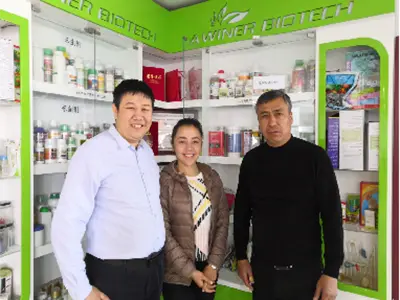
As a major manufacturer and global supplier of harvest aid formulations, China's competitive advantage extends beyond raw technical material (TC) synthesis. Advanced milling technology, suspension agent engineering, and flexible packaging design allow tailored delivery to diverse global markets.
Customizing ratio dynamics (e.g., TDZ 360g/L + Diuron 180g/L SC, or modified tank-mix adjuvant packages) to suit specific regional temperature profiles and aerial application viscosity requirements.
Every batch undergoes HPLC purity testing, particle size distribution analysis (d90 < 5 microns for SC formulations), suspension stability testing, and accelerated storage trials (54°C for 14 days).
Offering multi-size HDPE, COEX, and fluorinated bottles from 100mL to 20L, alongside UN-certified bulk drums (200L) and IBC totes (1000L) with customized multilingual labeling.
Navigating regulatory frameworks is critical for agricultural chemical importers. Registration dossiers require verified GLP test reports, environmental fate studies, and toxicological evaluations to meet local department of agriculture mandates.
The future of cotton defoliation lies in the integration of chemical formulation design with Ultra-Low Volume (ULV) Unmanned Aerial Vehicle (UAV) spraying systems. Traditional high-volume tractor-pulled sprayers consume hundreds of liters of water per hectare, whereas UAV applications require as little as 15–30 L/ha.
To support high-tech aerial application:
Formulations incorporate drift-control polymer adjuvants to prevent droplet evaporation and off-target drift during aerial passes.
Enhanced physical stability prevents chemical sedimentation when diluted in minimal water volumes for UAV tanks.
Variable-rate application mapping via satellite imagery and drone multispectral sensors optimizes defoliant dosage based on leaf area index (LAI).
 Awiner Biotech